

In a world where information is plentiful but insights are not, one company is forging the way by leveraging the potential of meaningful insights. These priceless bits of information are not simply numbers and charts; they are the gateway to opening up a competitive edge and propelling business success.
Understanding the Importance of Meaningful Insights

Let us first discuss what meaningful insights are before we venture into how this company is making use of them. Meaningful insights are not superficial analysis but provide a rich depth of information about your customers, industry trends, and internal operations. They provide actionable information that can be used in decision-making, strategy development, and innovation.
Meaningful insights rely on data analysis and interpretation. They help businesses obtain a sound understanding of their target market, competition, and market trends. These pieces of information enable companies to make informed decisions and optimize their operations.
But what makes insights “meaningful”? Well, meaningful insights go beyond simply collecting data. They are about digging deeper to uncover patterns, trends, and correlations that may not be immediately apparent. It’s about connecting the dots and finding valuable knowledge that can drive business growth and success.
Why Are They Crucial for Business Success?
Without meaningful insights, businesses are operating blindly. They may be making decisions based on assumptions or gut feelings, which can lead to costly mistakes and missed opportunities. On the other hand, companies that embrace meaningful insights have a competitive edge. They can identify emerging trends, anticipate customer needs, and pivot their strategies accordingly.
The Hidden Costs of Flying Blind: When Gut Feelings Fail
Imagine this: A CEO sits in a boardroom, with a pivotal decision looming that will make or break the future of their business. Without actionable insights, they are betting millions of dollars on guesswork and stale assumptions.
The bitter truth? 70% of business decisions fail because they are grounded on faulty or partial information. Businesses running without the guidance of data-based insights face the following catastrophic effects:
- Strategic Blind Spots: Costing an average of $15 million every year in missed opportunities.
- Resource Misallocation: 60% of marketing investments are squandered on inefficient campaigns.
- Competitive Disadvantages: Data-savvy rivals capture 23% more market share.
- Lost Revenue Opportunity: Worth as much as 8% of annual total revenue.
- Operating Inefficiencies: Siphoning off 15-20% of potential profitability. The question isn't whether you can afford to invest in meaningful insights—it's whether you can afford not to.

The Game-Changing Power of Insight-Driven Success
This is where the narrative gets thrilling. Companies that leverage meaningful insights do not merely exist—they conquer their markets with precision.
Market Clairvoyance: Smart companies anticipate customer behavior changes 6-12 months ahead of competitors.
Lightning-Fast Strategic Pivots: While others are arguing in meetings, insight-driven leaders make bold decisions within hours.
Innovation That Actually Sells: These companies see 3x higher success rates with new product offerings.
The Netflix Effect: Remember how Netflix pivoted from DVDs to streaming while Blockbuster clung to outdated models? That’s the power of meaningful insights in action.
Real-world evidence: Companies that employ sophisticated analytics are 5x more likely to act faster than the competition and 3x more likely to implement decisions successfully.
The Journey of the Company
Now that we understand the importance of meaningful insights, let's explore how one company embarked on a journey to leverage these insights and transform their business.
The Company's Background
Before incorporating meaningful insights into their strategy, the company had a solid foundation. They had built a reputable brand and a loyal customer base. However, they realized that standing still was not an option in a rapidly changing market.
Founded over two decades ago, the company started as a small family-owned business, operating out of a humble garage. Through sheer determination and a commitment to quality, they gradually expanded their operations and gained recognition in the industry. Their dedication to customer satisfaction earned them a loyal following, making them a trusted brand.
Implementing Meaningful Insights in Business Strategy

The Role of Data in Decision Making
With the abundance of data available, it can be overwhelming to separate the noise from the insights. The company invested in data analytics tools and systems to aggregate, analyze, and visualize their data. This allowed them to gain meaningful insights and make data-driven decisions.
The data analytics tools provided the company with the ability to slice and dice the data, uncovering patterns, trends, and correlations that were previously hidden. By leveraging advanced algorithms and machine learning techniques, they were able to extract valuable insights from vast amounts of data, allowing them to make informed decisions with confidence.
Moreover, the company understood that data is not limited to internal sources. They tapped into external data sets, such as market research reports, social media analytics, and customer feedback, to gain a holistic view of their industry and target market. This comprehensive approach ensured that their decisions were based on a thorough understanding of the market dynamics and customer preferences.
Training Teams to Interpret Data Effectively
Creating a data-literate workforce starts with hands-on training programs that go beyond basic analytics tools. Companies need to develop comprehensive learning paths tailored to different roles and skill levels. Entry-level employees might begin with dashboard interpretation and basic statistical concepts, while senior staff dive deeper into predictive modeling and trend analysis.
The most successful organizations establish data champions within each department. These power users receive advanced training and become internal consultants for their teams. They bridge the gap between complex analytics and practical business applications, helping colleagues understand what the numbers really mean for their daily decisions.
Interactive workshops work better than traditional presentations. Teams practice with real company data, working through actual scenarios they face. This approach builds confidence and ensures people can apply what they've learned immediately. Regular lunch-and-learn sessions keep skills sharp and introduce new analytical techniques as they become relevant.
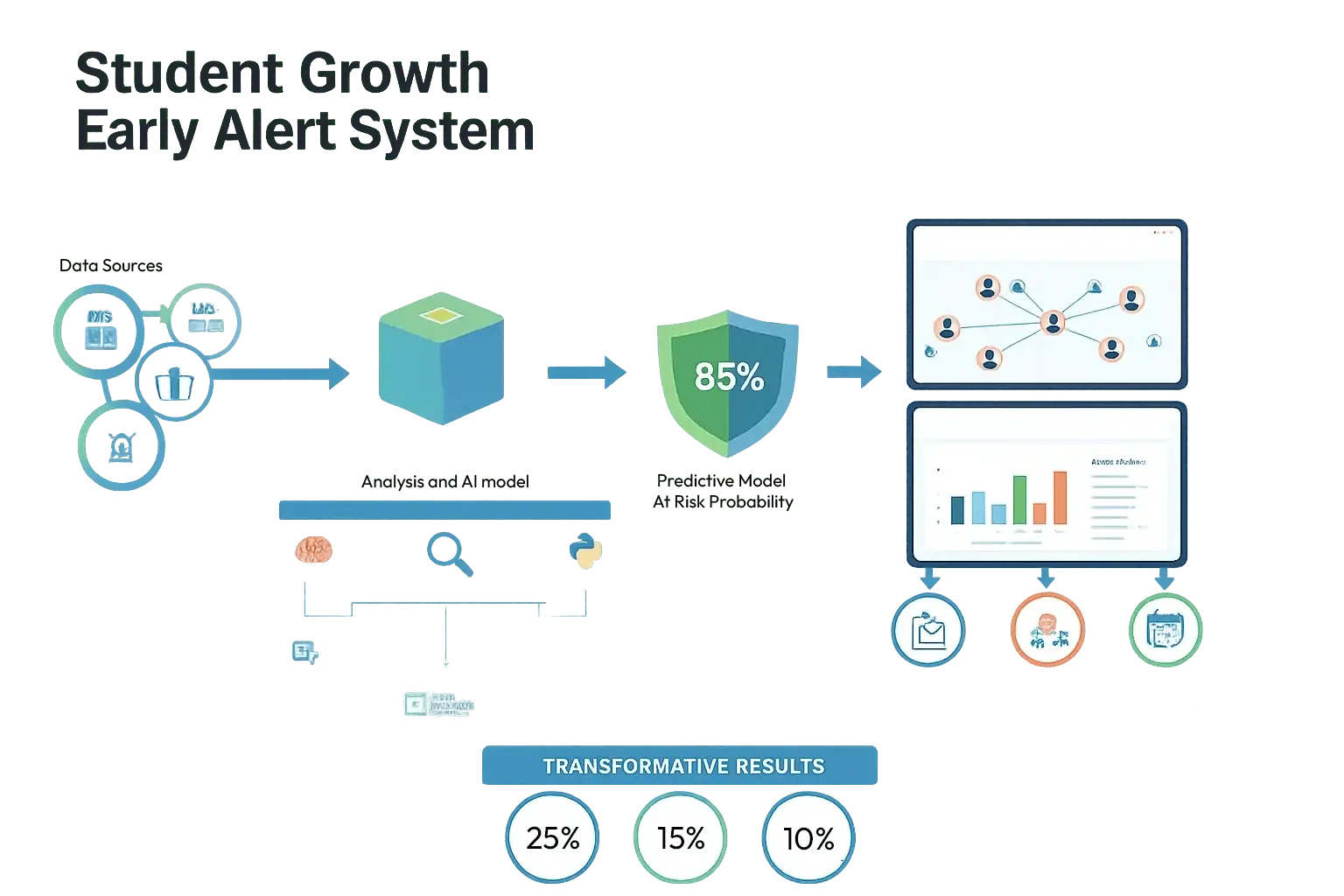
Case Study: Enhancing Student Growth Through a Data-Centric Approach
The Challenge: The Problem of "Too Little, Too Late"
In the traditional educational model, a student's academic trouble is often only fully recognized after they've failed a major exam or a semester ends. This reliance on lagging indicators means interventions happen when the student is already significantly behind, making recovery difficult and stressful.
A forward-thinking educational institution faced this exact problem. They possessed a wealth of student data, but it was fragmented across disconnected systems—a Learning Management System (LMS) like Canvas for course materials, a Student Information System (SIS) for enrollment, and separate platforms for library usage and online assessments. This created data silos, making it impossible to get a holistic, real-time view of a student's journey. The core challenge was to break down these silos and use the combined data to identify at-risk students before they stumbled, not after.
The Solution: Building a Unified and Predictive Ecosystem
The institution partnered with a technology firm to architect a modern data analytics solution focused on generating actionable insights.
1. Data Integration and Warehousing
The first step was to create a single source of truth. Using an ETL (Extract, Transform, Load) tool like Apache Airflow, data was automatically pulled from all the disparate sources. This unified data was then cleaned and organized into a cloud-based data warehouse like Snowflake or Google BigQuery, making it readily available for analysis.
2. Analysis and Predictive Modeling with Python Libraries
With the data centralized, a team of data analysts leveraged the Python ecosystem to perform analysis and build their predictive engine. Key libraries were crucial at different stages of the process:
Lessons Learned and Future Plans

After their journey of integrating meaningful insights into their business strategy, the company learned valuable lessons and laid out their plans for the future.
Throughout this transformative process, the company discovered that meaningful insights require a holistic approach. It is not just about collecting data; it is about analyzing it in the right context, transforming it into actionable insights, and executing strategies based on those insights.
One of the key takeaways from the company's experience was the importance of data analysis in the right context. They realized that simply collecting data is not enough; it is crucial to understand the underlying factors and variables that influence the data. By considering the broader context, the company was able to extract more meaningful insights and make informed decisions.
Looking ahead, the company aims to further enhance their data analytics capabilities and expand their insights-driven decision-making processes. They envision a future where every decision is backed by relevant data and insights, driving continuous innovation and growth.
With a firm commitment to data-driven decision-making, the company plans to invest in cutting- edge technologies that will enable them to gather and analyze data more efficiently. They understand that staying ahead in today's competitive landscape requires continuous improvement and adaptation.
Smart companies today know their data holds incredible value, but most struggle to unlock it. The real winners are those who move beyond just collecting information to actually turning it into something meaningful. They build solid systems that can handle their data properly, transform those raw numbers into clear insights, and most importantly, make sure their teams actually use these insights when making decisions.
The companies seeing the biggest wins aren't just investing in fancy analytics tools – they're creating a culture where data-driven decisions become second nature. They track how their improved analytics directly impact their bottom line, whether that's through better customer retention, smarter inventory management, or more targeted marketing campaigns. If your organization is sitting on unused data, now's the time to start digging. Begin small with one area that matters most to your business, prove the value, and then expand from there.

Empower Your Business Decisions with Datopic’s Insight-Driven Solutions
At Datopic Technologies, we transform raw data into meaningful insights that drive growth, efficiency, and innovation. Our analytics-driven strategies help organizations make smarter decisions, optimize operations, and stay ahead in a competitive world.
👉 Explore Services
👉 Request a Consultation
Turn your data into a competitive advantage—partner with Datopic and move from information to intelligent action.