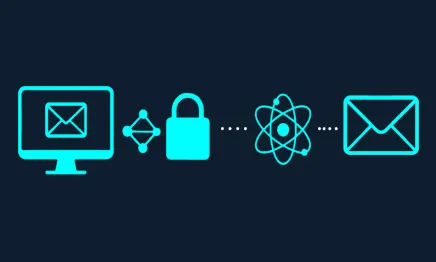
Email security has become a pressing concern in today's digital age. With the increasing sophistication of cyber threats, traditional methods of securing email have proven to be inadequate. However, there is hope on the horizon with the advent of decentralized quantum cryptography. This revolutionary approach combines the power of quantum mechanics with the concept of decentralization to provide unprecedented levels of security for our email communications.
Understanding the Basics of Quantum Cryptography
Before delving into the intricacies of decentralized quantum cryptography, it is essential to have a grasp of the fundamentals. Quantum cryptography is a branch of cryptography that leverages the principles of quantum mechanics to ensure secure communication. Unlike traditional cryptography, which relies on complex mathematical algorithms, quantum cryptography utilizes the laws of physics to protect the integrity of data.
Quantum cryptography, also known as quantum key distribution (QKD), is a method of sharing cryptographic keys between two parties securely. Through the use of quantum mechanical principles, such as the Heisenberg uncertainty principle and quantum entanglement, quantum cryptography provides an unhackable means of exchanging keys.
How Quantum Cryptography Works
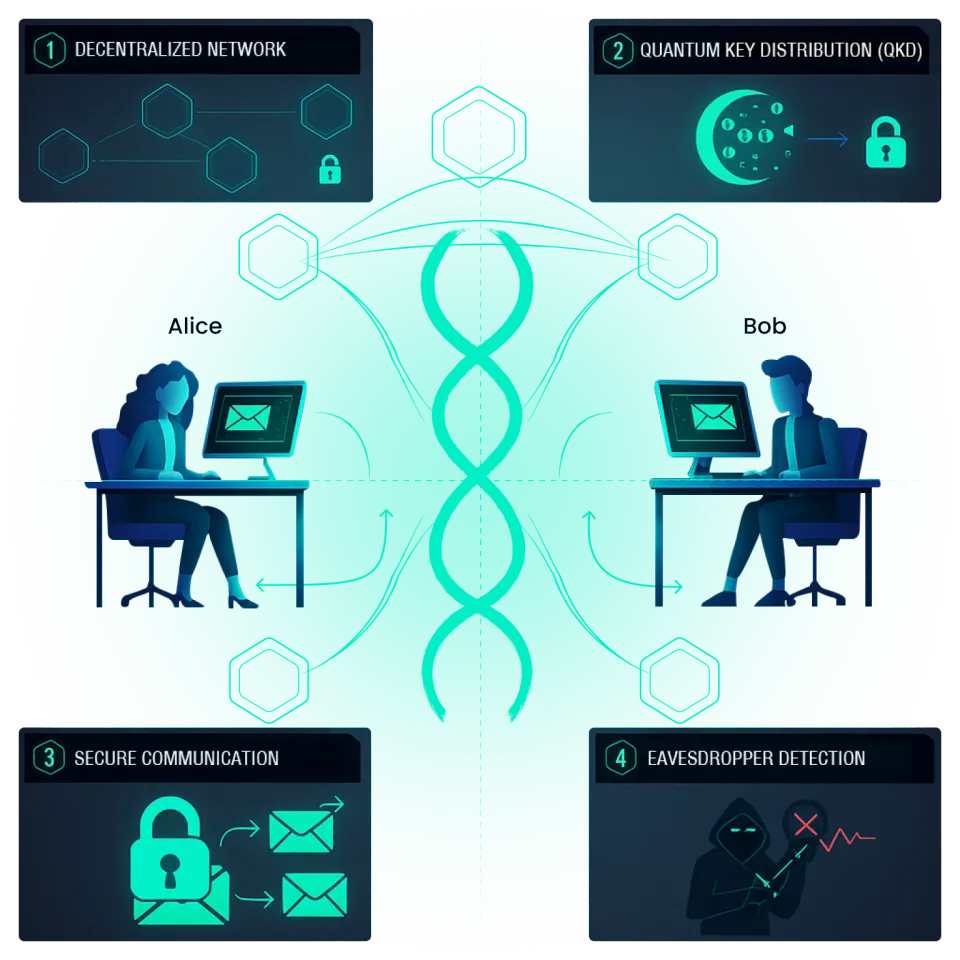
Imagine two parties, Alice and Bob, who want to communicate securely. They start by agreeing on a random string of bits that will serve as their encryption key. Alice then prepares a series of quantum particles, such as photons, each representing a bit of the key. She sends these particles to Bob over a quantum channel.
Due to the principles of superposition, each quantum particle can exist in multiple states simultaneously. In other words, a particle can be both a 0 and a 1 at the same time. However, as soon as someone tries to measure the state of a particle, it collapses into a definite value.
Bob receives the quantum particles sent by Alice and measures their states, obtaining a random string of bits. However, due to the Heisenberg uncertainty principle, any attempt to eavesdrop on the quantum channel would disturb the particles, causing errors in the measurements. This allows Alice and Bob to detect the presence of an eavesdropper and discard the compromised key.
Once Bob has measured the quantum particles, he communicates the measurement results to Alice over a classical channel. Alice compares Bob's results with her own, and they discard any bits where their measurements do not match. The remaining bits form their shared secret key, which can be used to encrypt and decrypt their messages.
Quantum mechanics plays a crucial role in the field of cryptography. It provides the foundation for secure key distribution and the development of quantum-resistant algorithms. By harnessing the peculiar properties of quantum particles, such as superposition and entanglement, we can achieve unprecedented levels of security in our cryptographic systems.
The Vulnerabilities of Traditional Email Security
Traditional email security methods, such as encryption and digital signatures, have long been relied upon to protect our sensitive information. However, with the advancement of technology, these methods have become increasingly susceptible to attacks.
In today's digital landscape, email security faces a myriad of threats that can compromise the confidentiality, integrity, and availability of our sensitive information. These threats are constantly evolving, requiring organizations and individuals to stay vigilant and adapt their security measures accordingly.
Common Email Security Threats
- Phishing Attacks – Cybercriminals impersonate trusted entities to trick users into revealing sensitive information like passwords or credit card details.
- Malware-infected Attachments – Disguised as harmless files, these can infect the recipient's device, compromising the system and exposing data.
- Email Spoofing – Attackers forge the sender's address, making emails appear from a trusted source, enabling social engineering attacks.
Limitations of Conventional Cryptography
Conventional cryptography, while effective in many scenarios, is not immune to vulnerabilities. Its reliance on complex algorithms that can be cracked through brute force or mathematical advancements puts our email communications at risk.
- Centralization Risks – A single authority managing cryptographic keys can become a single point of failure.
- Man-in-the-Middle Attacks – If attackers gain access to email servers, they can intercept and alter communications.
As the vulnerabilities of traditional email security methods continue to be exploited, it is crucial to explore alternative approaches.
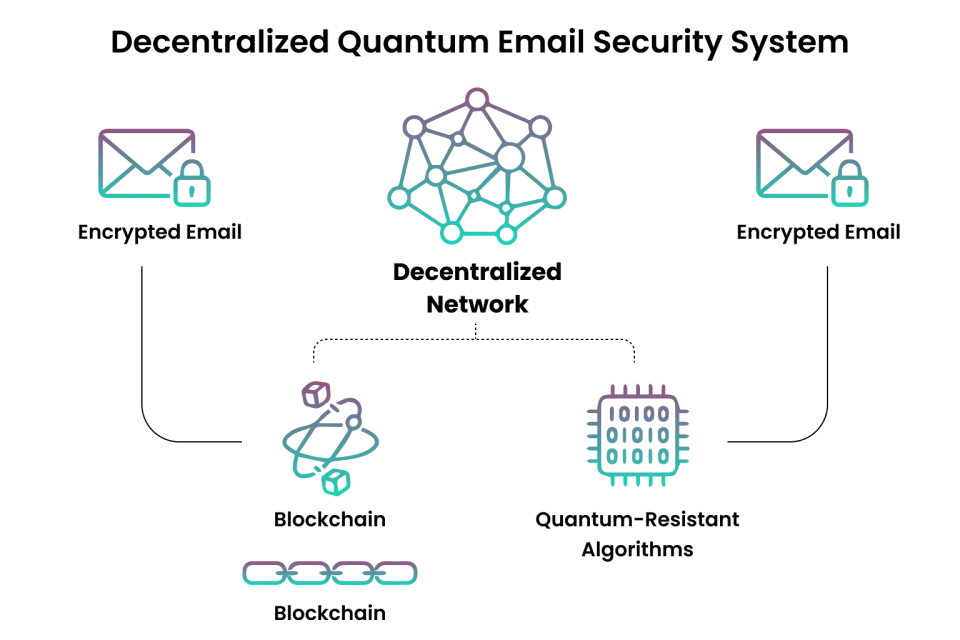
The Intersection of Decentralization and Quantum Cryptography
Decentralization has gained significant attention in recent years. In the realm of cryptography, combining decentralized systems with quantum cryptography can revolutionize email security.
The Concept of Decentralization in Cryptography
Decentralization distributes control across multiple nodes, removing reliance on a single authority.
- Ensures redundancy and fault tolerance.
- Reduces trust dependency on a central authority.
- Minimizes risks of unauthorized access.
How Quantum Cryptography Enhances Decentralization
- Eavesdrop Detection – Any interception attempts are immediately noticeable.
- Quantum-Resistant Algorithms – Future-proofing security against quantum computers.
By combining decentralization with quantum cryptography, the future of email security looks promising.
Implementing Quantum Cryptography in Email Security
Implementing quantum cryptography requires cutting-edge technology and well-defined protocols.
The Process of Quantum Key Distribution
- BB84 Protocol – Uses photon polarizations for secure key exchange.
- E91 Protocol – Uses entangled particles to detect eavesdropping.
Quantum-Resistant Algorithms for Email Security
- Lattice-based Cryptography – Relies on hard mathematical problems.
- Code-based Cryptography – Uses error-correcting codes to detect and correct errors.
These ensure resilience against both classical and quantum computer attacks.
The Future of Email Security with Quantum Cryptography
Potential Challenges and Solutions
- Scalability – Implementing large-scale decentralized systems.
- Compatibility – Integrating with existing infrastructures.
The Impact on Privacy and Security
Decentralized quantum cryptography ensures secure, private communication, safeguarding sensitive information.

Partner with Datopic to Build Quantum-Secure Communication
At Datopic Technologies, we specialize in designing and implementing cutting-edge security architectures that merge decentralization with quantum cryptography. Our solutions empower enterprises to future-proof their communication systems against evolving cyber threats and quantum-era attacks.
👉 Explore Services
👉 Request a Consultation
Let Datopic help you secure the future of digital communication with quantum-ready, decentralized solutions.