


Artificial Intelligence (AI) has moved from research labs to powering everyday life — from the algorithms curating our news feeds, to the models assisting doctors, to the systems detecting fraud in financial transactions. As adoption accelerates, AI is no longer just a technical challenge. It is a social, ethical, and governance challenge. This is where Responsible AI (RAI) comes in. Responsible AI ensures that as we innovate, we do so with fairness, transparency, accountability, and security at the core. Without these guardrails, AI risks eroding trust instead of building it. Can we create AI systems that people genuinely trust ?
Why Responsible AI Is Urgent

AI is immensely powerful, but power without checks is risky:
-
Bias and Fairness
AI models learn from data, and data often reflects societal biases.
Without intervention, algorithms may amplify discrimination in hiring, lending, healthcare, and policing. -
Transparency
Many advanced models function as “black boxes,” making decisions that lack explainability.
For critical applications, such opacity is unacceptable. -
Privacy and Security
AI systems depend on sensitive data.
Without robust safeguards, personal information can be exposed or weaponized through adversarial attacks. -
Accountability
When AI systems fail — whether through wrongful denial of benefits, medical misdiagnosis,
or biased loan decisions — the question remains: who is responsible?
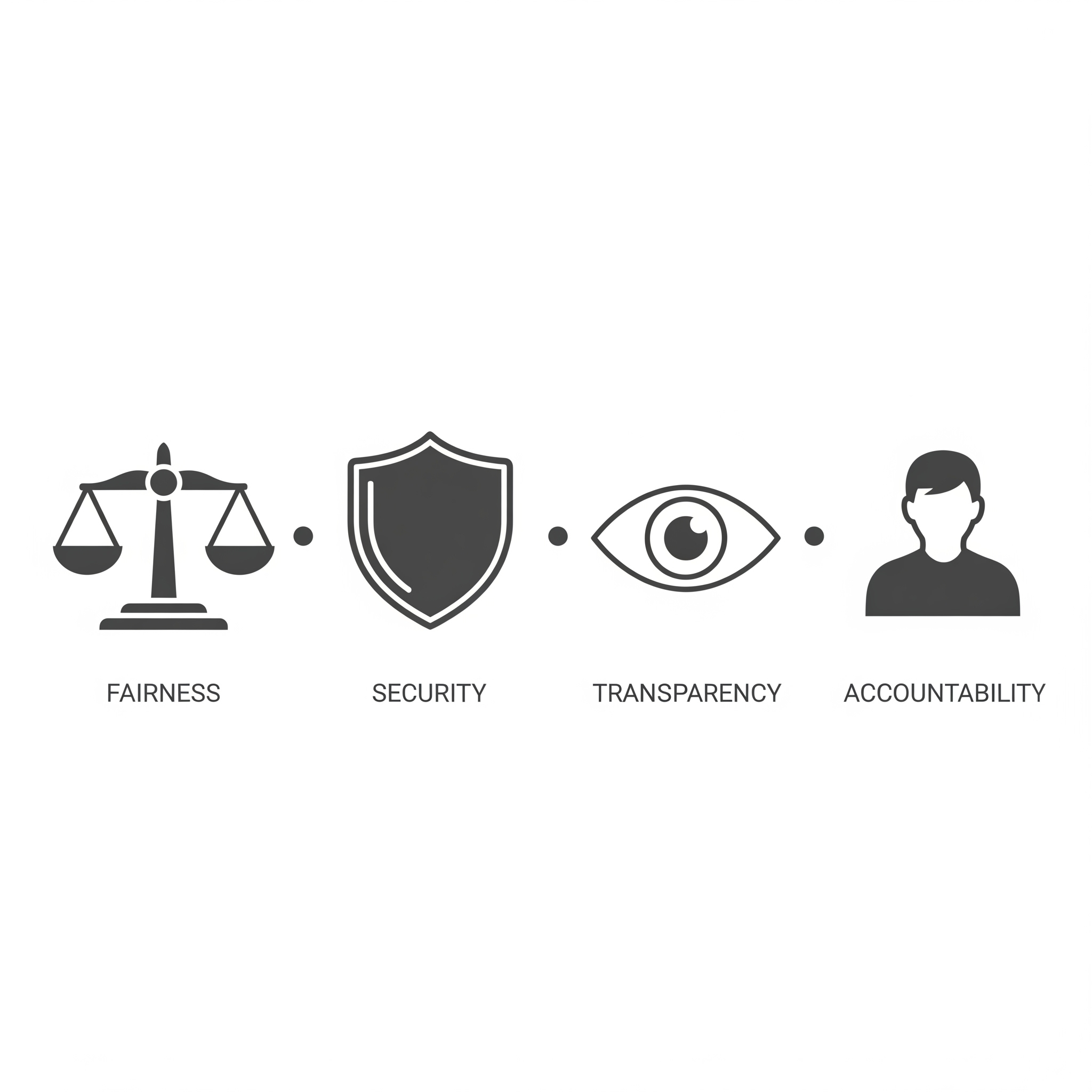
Core Principles of Responsible AI
-
Fairness
AI should provide equitable outcomes regardless of race, gender, geography, or socioeconomic status.
This requires conscious efforts to identify, measure, and reduce bias in datasets and models. -
Transparency & Explainability
Users and regulators should understand how AI reaches conclusions.
Explainable AI (XAI) enables stakeholders to trace decision-making, boosting trust and adoption. -
Privacy & Security
Data protection laws like GDPR set a baseline, but AI needs stronger measures such as:- Differential privacy
- Secure multiparty computation
- Post-quantum security for long-term resilience
-
Accountability & Governance
Clear frameworks are needed for oversight.
Human-in-the-loop decision-making, audit trails, and robust compliance policies ensure AI remains accountable to human values.
Regulations Are Catching Up

Governments worldwide are responding with frameworks to guide ethical AI:
-
EU AI Act
Introduces risk-based regulation, restricting harmful use cases like social scoring and mandating transparency for high-risk applications. -
NIST AI Risk Management Framework (US)
Provides guidance on trustworthy AI, covering security, explainability, and fairness. -
Global Initiatives
From UNESCO’s AI ethics recommendations to OECD guidelines, international collaboration is accelerating.
👉 Compliance isn’t just about avoiding penalties — it’s about aligning with global trust standards.
Are organizations ready to meet these rising expectations?

The Business Case for Responsible AI
Beyond regulation, enterprises have strong incentives to adopt Responsible AI:
-
Trust = Adoption
Customers and partners are more likely to embrace AI systems they trust. -
Reputation Protection
Ethical failures in AI can cause massive brand damage. -
Long-Term Value
Responsible AI reduces risks, ensuring systems are resilient against both present-day and emerging threats (like quantum attacks).
In short: responsibility drives business sustainability.
Datopic’s Commitment to Responsible AI
At Datopic, we believe innovation without responsibility is incomplete.
Our AI systems are designed with:
- Bias detection and mitigation pipelines to ensure fairness.
- Explainability modules so decision-making can be understood by stakeholders.
- Privacy-preserving methods like encryption, differential privacy, and quantum-resistant cryptography.
- Strong governance controls that integrate seamlessly with compliance frameworks.
👉 Responsible AI isn’t just a checkbox for us — it’s a foundation.
Isn’t it time every AI initiative started with responsibility?
Looking Ahead
As AI systems grow more powerful, their impact on society will only deepen. The organizations that lead in Responsible AI today will define the trust standards of tomorrow.
Building trust is not optional. It is essential. By embedding responsibility at every layer — data, model, governance, and security — we can ensure that AI remains a force for good, not division.
👉 At Datopic, we’re working at the intersection of AI, Blockchain, and Cybersecurity to ensure innovation is not just cutting-edge, but also trustworthy.
If you’d like to explore how our Responsible AI frameworks can strengthen your business,connect with us at: www.datopic.com

Datopic: Your Partner for Responsible AI & Edge Solutions
At Datopic Technologies, we believe innovation without responsibility is incomplete.
Our Responsible AI frameworks are built on fairness, transparency, privacy, and governance — ensuring that AI adoption drives trust, not risk.
👉 Explore Services
👉 Request a Consultation
Let Datopic help you build the edge-first architecture your users deserve.